How To Make Sure AI Recommends You (Not Your Competitor)
By Nader Alnajjar

TLDR
In 2026 nobody Googles your name; they ask ChatGPT or Claude, and if you do not show up in those answers you are invisible. Gartner reports traditional search volume has already dropped by 25%.
AEO (Answer Engine Optimisation) is optimising to appear in AI-generated answers rather than search engine results alone. AI models read everything public about you: LinkedIn posts, articles, podcasts, and mentions in other people's content.
Your website is the anchor and the strongest EEAT signal you can send (Experience, Expertise, Authoritativeness, Trustworthiness). LinkedIn and newsletters are supporting channels.
Four moves get you recommended by name: a website that tells your full story, 3 to 5 positioning phrases used consistently, mentions by other people, and content that answers genuine questions in prompt form.
In 2026, nobody is Googling your name anymore. They ask ChatGPT and Claude. And if you don't show up in those answers, you’re pretty much invisible.
Search has completely changed, and most founders haven't caught up yet.
But that changes today.
Build Leverage By Learning:
What AEO is (and why it matters more than SEO for founders)
Where AI actually pulls its answers from (LinkedIn is just the start)
4 ways to make AI recommend you by name
What we're doing at LeverBrands to stay ahead of this
What is AEO + Why Does It Matter For Your Personal Brand?
It used to be simple: someone types your name into Google, scans the first few websites, and then makes whatever decision they need to from there.
That’s not how it works anymore.
Now, people open an AI model like ChatGPT or Claude and ask: "Who's the best personal branding agency for founders?" or "Who should I hire to help me grow on LinkedIn?" They get a summary, then make a decision based on that answer, often without clicking a single link.
This right here is AEO, or Answer Engine Optimisation. And according to Gartner, it’s caused traditional search volume to already drop by 25%
But the volume isn't the strategy in itself. It's a byproduct of one. He records one or two long-form pieces and turns each into 50+ assets: YouTube cuts, Reels, TikToks, threads, LinkedIn posts, email content, carousels. The whole thing runs like a production line.
To put the difference simply:
SEO = optimising so you appear in search engine results.
AEO = optimising so you appear in AI-generated answers.
But these AI models don’t pull their answers from thin air. They read everything publicly available about you: your LinkedIn posts, articles you've written, podcasts you've appeared on, mentions of you in other people's content. Then they compress it into a response, and that response either positions you as the go-to, or leaves you out entirely.
Working closely with Chris Donnelly as he transitioned into the AI space is a big reason why AEO has been top of mind for us lately, especially seeing how far behind most founders are on this.
If we go back to our Personal Brand Ecosystem…
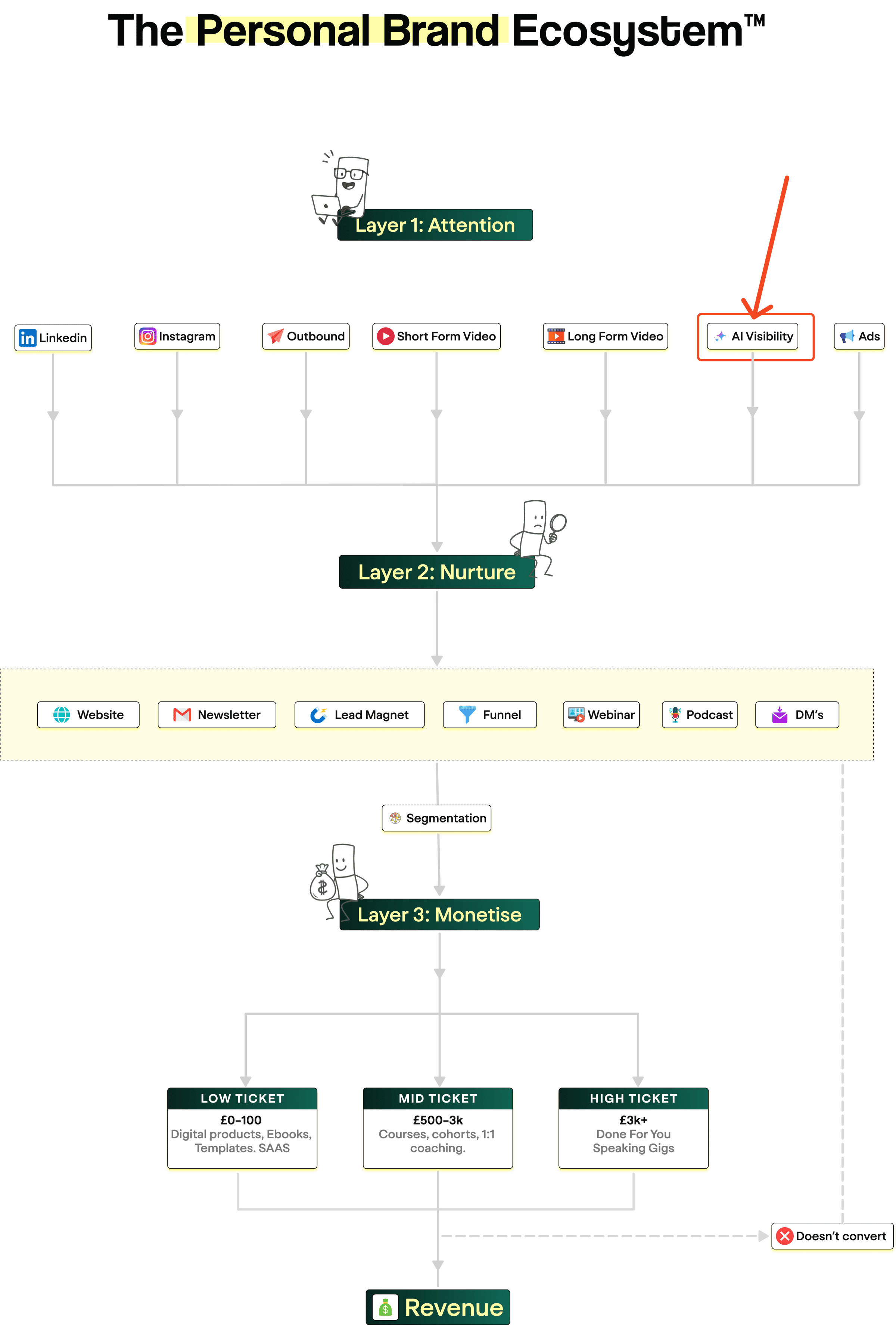
AEO is the newest part of the attention layer. And as a founder, you need to make sure you’re not leaving your AI-visibility to chance.
Where Does AI Pull Its Answers From?
The single most important source of information when it comes to AEO is your website (which is ironic, as most founders treat it as an afterthought).
Your website is the one place on the internet that's entirely yours. It's where your full story lives: who you are, what you've built, what you believe, who you help. Think of LinkedIn and newsletters as supporting channels, while your website is the anchor.
When AI tries to figure out who you are, it's looking for something called EEAT:
Experience
Expertise
Authoritativeness
Trustworthiness
A well-built personal website is the strongest EEAT signal you can send. Pair that with consistent messaging across your LinkedIn, newsletter, and other channels, and you're giving AI a clear, unified picture of you that it can actually recommend.
So, if you’ve been building a presence on LinkedIn properly up until now, you’re ahead of most people.
But that’s only the first step.
4 Ways You Can Get Recommended by AI
Now that you have an idea of how it works, what can you do to increase your chances of getting recommended?
1. Build your website as your source of truth
Your website should tell your full story in one place: who you are, what you've built, what you believe, and who you help. Clear bio, your services, case studies, long-form thinking. This gives AI a structured, high-authority source to pull from and cross-reference everything else you create.
2. Be specific and consistent with your positioning
Pick 3-5 phrases you want to own and use them consistently across your LinkedIn, website, content, any interviews you do, etc. That repetition and consistency is how AI learns what to associate you with (same as how the LinkedIn algorithm works).
3. Get mentioned by other people
One of the most underrated parts of AEO. AI also reads what others say about you, and third-party mentions actually carry more weight because they act as independent validation.
This ties directly into what we call “borrowed authority” in your personal brand strategy: things like earned mentions by other LinkedIn pages, tags in other people’s posts, co-authored content etc.
4. Create content that answers genuine questions
AI surfaces content that directly responds to queries more so than opinion pieces. So one detailed breakdown of a framework is worth more than 30 generic tips.
This means you need to think in prompts rather than keywords. Back in the SEO days, you’d type something like "personal branding agency UK." But nobody inputs that into ChatGPT. They ask: "Who should I hire to build my personal brand as a founder?" or "What's the best way to generate leads from LinkedIn?" Your content should be answering those questions naturally.
What We’re Doing About This At LeverBrands
I'll be transparent: this is something I've been working on myself.
A few weeks ago, I launched my personal website, naderalnajjar.com, and it was built specifically with AEO in mind. The website is a full reflection of who I am as a founder: my story, the thinking behind LeverBrands, the frameworks we use, the results we've driven. Every layer of the personal brand ecosystem is represented there in one place.
We've also started turning all past Building Leverage newsletters into indexable blog content on our website. Every issue you've read over the past months is getting repurposed so that AI tools can actually find and cite it. Same goes for our lead magnets and frameworks.
Honestly, this is something I'd recommend every founder starts doing now. The results won’t be instant, but everything adds up massively. Every piece of content you make citable today is one more data point AI has to work with six months from now. The earlier you build this foundation, the harder it becomes for someone else to catch up.
We're treating AEO the same way we treated personal branding on LinkedIn five years ago: paying attention and taking action when most people aren’t.
Until next time,
Nader 🫡
P.S. We're currently building an AEO package at LeverBrands designed to boost founders' online presence across AI search (check out my website naderalnajjar.com to see what this looks like). If you want to be one of the first to get access, reply "AEO" and I'll get you an early bird offer.
P.P.S. Otherwise, if you have any questions or just want to say hi, please reply as well! We read every single response, and it helps keep us out of your spam.
What this means for you
The people who decide your next client engagement, your next funding conversation and your next senior hire are already asking AI models who you are, and the answer comes back assembled from whatever public record exists: your website, your LinkedIn presence, your articles, and what other people say about you. If that record is thin or scattered, the model recommends someone else, and you never even know the conversation happened. For founders and executives this makes AI visibility part of the personal brand itself: being findable and citable by answer engines is now what earns the recommendation, in the same way LinkedIn authority earned it over the past five years.
The work is unglamorous and it compounds. Treat your website as the single source of truth for who you are, what you have built and who you help, then repeat the same 3 to 5 positioning phrases across every channel so the models learn what to associate with you. Earn mentions from other people, because independent validation carries more weight than anything you say about yourself, and publish thought leadership that answers the questions your buyers actually put to ChatGPT, phrased as questions rather than keywords. Every citable piece you put out now becomes a data point a model can draw on months later, which is exactly why starting early makes you hard to displace.
Frequently asked questions
What is AEO (Answer Engine Optimisation)?
AEO is optimising so you appear in AI-generated answers, where SEO is optimising so you appear in search engine results. People now open ChatGPT or Claude and ask questions like "Who's the best personal branding agency for founders?", get a summary, and make a decision from that answer, often without clicking a single link. According to Gartner, this shift has already caused traditional search volume to drop by 25%.
Where do AI models pull their answers about you from?
From everything publicly available: your LinkedIn posts, articles you have written, podcasts you have appeared on, and mentions of you in other people's content. The single most important source is your website, the one place on the internet that is entirely yours. AI looks for EEAT (Experience, Expertise, Authoritativeness, Trustworthiness), and a well-built personal website is the strongest EEAT signal you can send, with LinkedIn and newsletters as supporting channels.
How do you get AI to recommend you by name?
Four ways. Build your website as your source of truth, with a clear bio, services, case studies and long-form thinking. Pick 3 to 5 positioning phrases and use them consistently everywhere, because repetition is how AI learns what to associate you with. Get mentioned by other people, since third-party mentions act as independent validation, what the newsletter calls borrowed authority. And create content that answers genuine questions, thinking in prompts rather than keywords.
How long does AEO take to work?
The results are not instant, but they add up. Every piece of content you make citable today is one more data point AI has to work with six months from now, and the earlier you build the foundation, the harder it becomes for someone else to catch up. That is the case for starting now, the same way early movers built LinkedIn authority by paying attention and taking action before most people did.
Related reads
About the author
Nader Alnajjar is co-founder of LeverBrands, where he builds personal brands and content ecosystems for founders and executives. More at leverbrands.com/about and on LinkedIn.