How To Turn Your Story Into a Conversion Tool
By Nader Alnajjar

TLDR
Most people treat the LinkedIn About section as a longer CV because it sits last in the profile flow. It is actually the most human section you have, and done right it can sell your value 24/7.
Your story is a business asset: people decide in the About whether they like you, trust you, and believe your claims. One client rewrite produced a first conversion within three days, directly from the About.
The perfect structure has three parts: Origin (why you do what you do), Authority (why people should listen to you), and Alignment (who you help, their pain points, and how you help them).
Three templates cover most stories: Vision-Driven, Results-Driven, and Pain-Solution-Program. Write in first person, aim for 3 to 5 paragraphs, and tell a story rather than listing achievements.
Done wrong, your About Section simply doubles as your CV. But done right... it can sell your value 24/7.
And the fix is pretty formulaic.
Let's get into it.
Build Leverage By Learning:
Why your story can be your greatest business asset
What is the 'perfect structure'?
3 About Section Templates
Tips and best practices
Why your story can be your greatest business asset
Too many people still underestimate the value of a LinkedIn About section. All because it’s the last part of the ‘flow’ of your profile.
Let me explain.
Someone sees your name on their feed. The first thing that draws them in is your headline, aka the 2 lines that summarise exactly what you do and how you help people (we won’t go into headlines too much here, but if you need help making one, use our Headline Generator).
Once they click on your profile, they see your banner → a more visual summary of who you are and what you do.
And then… they get to your About section. The last stop on your profile before your content.
You might think that if they’ve already made it this far, they’ll probably just jump straight to the posts and won't bother reading all of this.
So you either treat it like a more long-winded version of your CV, or end up just talking about what university you went to and what sports you like.
But doing either of these is a complete wasted opportunity.
Your About is the most human section on your profile.
It sells your story.
It’s where people decide whether they like you, can trust you, or believe in whatever you're claiming.
And if you want someone to buy your service, they have to buy into your story first.
But I'm not just saying this theoretically. If it's optimised correctly, you can literally drive direct leads from your About section.
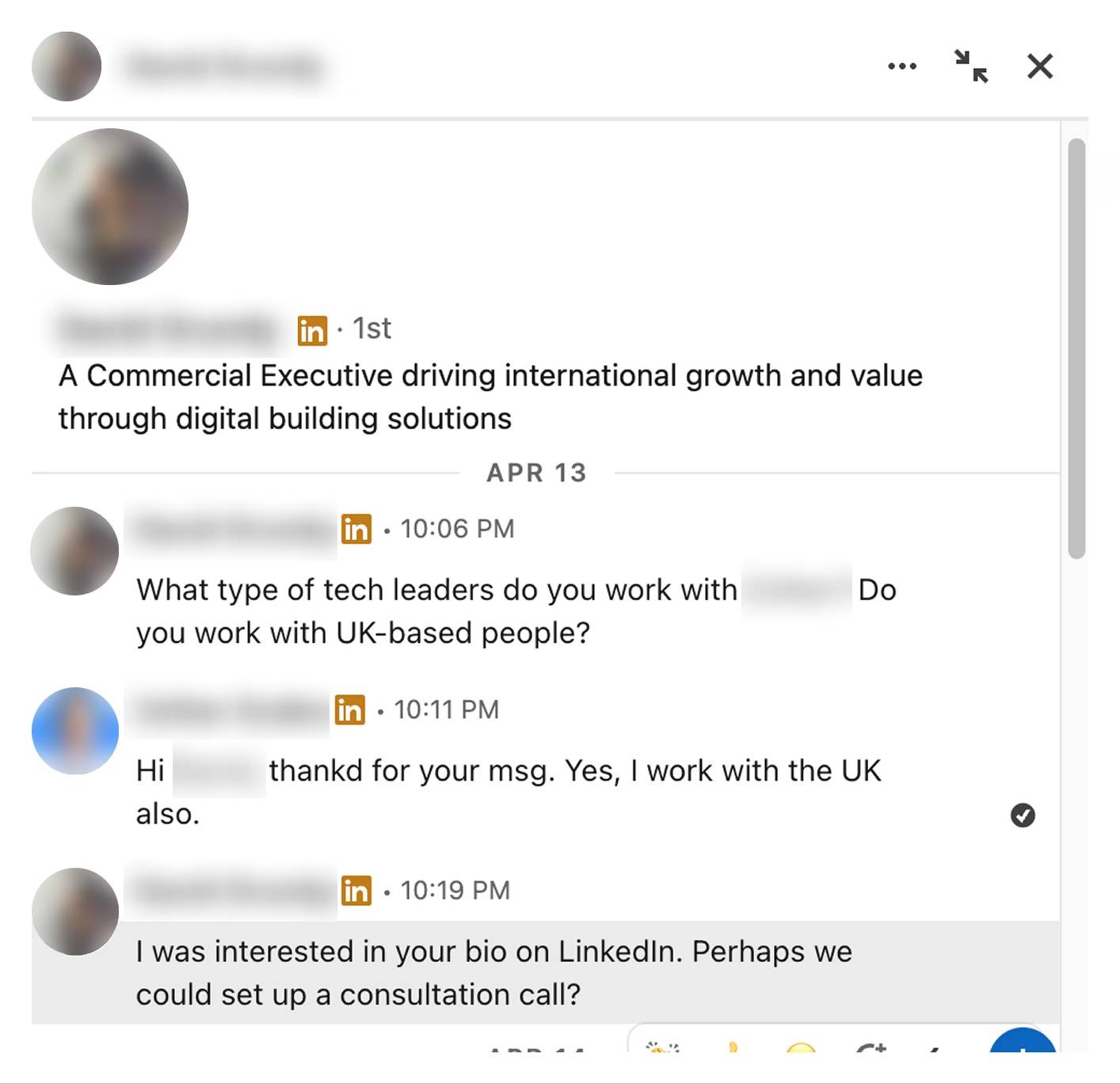
In case you think I’m exaggerating, let me tell you about one of our past clients: we rewrote his About section to include a tighter positioning and clearer pain points, all tied together by a stronger and more emotive narrative.
Within just 3 days, he got his first conversion. Coming directly from his About.
So no, this isn’t a filler part of your profile.
It’s leverage you’re probably ignoring.
What is the 'perfect structure'?
It's probably not as complicated as you think. There are 3 main parts to the perfect About:
Origin → Why you do what you do. Keep this as human as possible.
Authority → Why people should listen to you (what results, skills or credibility do you have?)
Alignment → Who you help, their pain points, and how you can help them services-wise.
If you touch on all of these, you'll take your reader on the right kind of emotional journey that makes them take action.
But the order in which you go through these points can vary depending on how you want to tell your story.
Take a look at these templates below.
3 About Section Templates
(Or, if you want to try building one yourself, use our About Section Generator.)
Template 1: Vision-Driven
I believe [bold statement/core philosophy].
My journey started [origin story: early career or first venture]. Since then, I’ve [scaled, exited, built, coached, invested…]. Along the way, I’ve had the privilege of working with [big clients, industries, or milestones].
But here’s what I see most leaders/entrepreneurs/professionals struggle with:
[Barrier 1]
[Barrier 2]
[Barrier 3]
Today, I dedicate my work to helping [target audience/ICP] [achieve X outcome]. Whether it’s through [method/service], my goal is simple: empower you to [desired end result].
If this resonates, let’s connect. I’m always open to conversations with [audience type] who want to grow, build, and make an impact.
Template 2: Results-Driven
📣 [Big statement about what matters in your industry] 📣
Without it, [pain point]. With it, [desired outcome].
I’ve helped [clients/companies] unlock this advantage by [your method]. Some results:
[Proof point 1]
[Proof point 2]
[Proof point 3]
If you’re [audience], chances are you’re stuck dealing with [challenge], [challenge], and [challenge].
I step in with [your expertise/services], giving you a clear path to [desired transformation].
Curious to see how this could work for you? Reach out or follow me here for insights you can put into action.
Template 3: Pain-Solution-Program
Hi, I’m [Your Name], and I help [audience: e.g., executives/professionals] break through [pain point] and land [desired outcome].
I know how it feels to be:
🔴 [Pain Point #1]
🔴 [Pain Point #2]
🔴 [Pain Point #3]
I’ve been there too. But I broke through, going from [role] to [senior role].
Now I help others do the same, so they can:
✅ [Benefit #1]
✅ [Benefit #2]
✅ [Benefit #3]
Through my [Program Name], an [X-week] program, I guide you step-by-step with:
[Method #1]
[Method #2]
[Method #3]
👉 Click the link in my bio if you’re interested.
A few more tips and best practices:
Write in first-person → Creates a sense of intimacy and trust (there’s nothing more jarring than reading about someone in third-person).
Keep the tone authentic → Write how you'd speak. People connect more with emotive and informal language.
Aim for 3-5 paragraphs → Too long, and people won't bother reading through it all. Too short, and you're probably not communicating all the value you need to.
Use more keywords → Words your ideal audience is more likely to search for.
Telling a story > listing achievements → Nobody cares about your past job titles. They want to be taken on an emotional journey.
Use Hemingway Editor → Can tell you which grade level your writing is at, which helps improve readability. Aim for Grade 5-7 to maximise dwell time.
Don't waste valuable space on your profile.
Get this right once, and it'll work for you 24/7.
Until next time,
Nader
What this means for you
If you are a founder or executive, your About section is doing one of two jobs right now: repeating your CV, or selling your story. Most profiles default to the first, because the About sits at the end of the profile flow and feels like an afterthought. In practice it is where a prospective client, investor or senior hire decides whether they trust the person behind the company. A founder-led brand runs on that trust, and as the client example here shows, a tighter narrative with clearer positioning and pain points can drive inbound leads directly from the profile, within days rather than months.
The practical move is to audit your About against the three-part structure: Origin, Authority, Alignment. If any part is missing, rebuild it with whichever template matches how you want to tell your story, then apply the basics: first person, an authentic tone, 3 to 5 paragraphs, keywords your audience actually searches, and a story rather than a list of job titles. Unlike a post, this is a fix you make once and benefit from continuously. Every piece of thought leadership you publish sends readers back to your profile, and a strong About converts that LinkedIn authority into conversations with the people your personal brand is built to reach.
Frequently asked questions
Why does your LinkedIn About section matter?
Because it is the most human section on your profile. Your headline and banner draw people in, but the About is where they decide whether they like you, can trust you, or believe what you are claiming. If you want someone to buy your service, they have to buy into your story first. It is also a direct lead channel: after one client's About was rewritten with tighter positioning and clearer pain points, he got his first conversion within three days, coming straight from the About section.
What is the perfect structure for a LinkedIn About section?
Three parts. Origin covers why you do what you do, kept as human as possible. Authority covers why people should listen to you: your results, skills or credibility. Alignment covers who you help, their pain points, and how you can help them at a service level. Touch on all three and you take the reader on the kind of emotional journey that makes them act. The order can vary depending on how you want to tell your story.
Which About section template should you use?
Nader gives three. Vision-Driven opens with a bold statement of your core philosophy, walks through your journey and milestones, names the barriers your audience struggles with, and closes with who you help and how. Results-Driven leads with a big statement about what matters in your industry, backs it with proof points, then maps your audience's challenges to your services. Pain-Solution-Program names the pain points you have lived through yourself, the breakthrough, the benefits, and the step-by-step programme that delivers them. Pick the one that matches how you want to tell your story.
How long should a LinkedIn About section be?
Aim for 3 to 5 paragraphs: too long and people will not read it all, too short and you are probably not communicating your value. Write in first person to create intimacy and trust, keep the tone authentic and close to how you speak, use keywords your ideal audience searches for, and tell a story rather than listing achievements. Running the copy through Hemingway Editor and aiming for Grade 5 to 7 readability helps maximise dwell time.
Related reads
About the author
Nader Alnajjar is co-founder of LeverBrands, where he builds personal brands and content ecosystems for founders and executives. More at leverbrands.com/about and on LinkedIn.