Personal Brand vs Personal Brand Ecosystem: Why Posting Is Not a Strategy
By Nader Alnajjar

TLDR
A personal brand is what people see: your profile, your posts, your name in the feed. A personal brand ecosystem is the system of positioning, content, owned audience and offers that turns a founder's attention into trust and revenue.
Most founders build the first and expect the results of the second. That is why months of consistent posting can produce followers and no clients.
The three layers are Attention, Nurture and Monetise, underpinned by positioning. Skip a layer and the next one has nothing to work with.
Posting is one activity inside the Attention layer. It is not a strategy.
If you are a founder or CEO who has been posting on LinkedIn for months, getting likes, maybe even growing a following, and you still have not seen a client come out of it, this article is for you. Nothing is wrong with you and nothing is wrong with the algorithm. You have built a personal brand. What you have not built is a personal brand ecosystem, and the two are not the same thing.
Pretty much every founder I speak to has the same problem. So here is the difference, why it matters more than any format or hook, and what the full system looks like when it is working.
What is a personal brand?
A personal brand is the impression people form of you from what they can see. On LinkedIn that means your profile picture, your headline, your About section, your banner and the content you post. It is the surface: the thing people react to and follow.
You need that surface. A clear profile and content that speaks to your audience is the entry point to everything else. The problem is that most founders treat the surface as the whole project. They optimise the profile, commit to posting three times a week, and wait for the business to arrive.
It does not arrive, because attention on its own has no mechanism for becoming revenue.
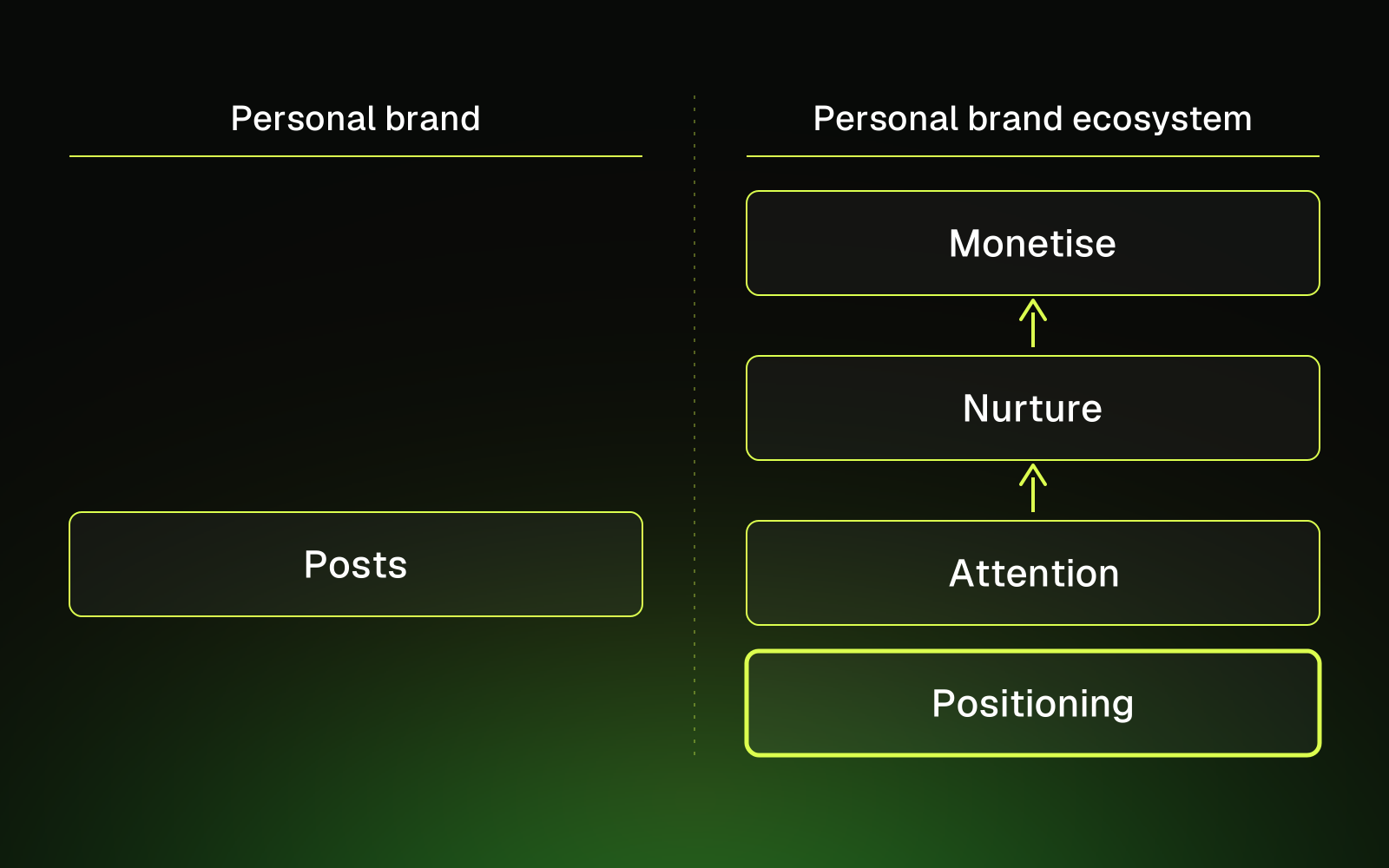
What is a personal brand ecosystem?
A personal brand ecosystem is the system of positioning, content, owned audience and offers that turns a founder's attention into trust and revenue.
Content is one word in that definition. The other three, positioning, owned audience and offers, are the parts most founders never build. The ecosystem is the whole machine: what you want to be known for, the content that attracts the right people, the place you take them once they are interested, and the thing they can eventually buy from you.
LeverBrands builds personal brand ecosystems for founders and CEOs. The three layers are Attention, Nurture and Monetise, underpinned by positioning. We call this the LeverBrands Ecosystem Model. In the last three years, our clients have achieved 1B+ impressions generated, £20M+ client revenue and 15M+ followers grown.
Positioning: the foundation
Before anyone posts anything, answer one question: what do you want to be known for, and by whom? That means your target audience, your value proposition and how you differ from everyone else doing what you do.
The most common mistake is to start creating content without it. The posts go out, nothing comes back, and the reason is that people cannot tell who you are, how you can help them, or in some cases what you even offer. There is no point generating attention if it is not clear how someone can buy from you.
The opposite mistake is thinking about positioning for so long that nothing ever launches. Positioning can change. Start with an angle, publish, see what your audience responds to, and adjust.
Layer one: Attention
This is where the right people find you. On LinkedIn it is your profile and your content. Off LinkedIn it is short-form video, distribution through other pages and newsletters, and inbound and outbound outreach.
Attention is the layer everyone sees, which is why it gets mistaken for the whole ecosystem. It is also the layer that fades fastest. Someone sees your post today and has forgotten you by tomorrow. Attention that is not captured somewhere you control disappears.
Layer two: Nurture
This is where people come to trust you. Very few people read one LinkedIn post and act on it. Most look, maybe follow, and scroll on. The Nurture layer exists so you can keep giving that person value over time, until they are ready to buy.
In practice that means moving your audience off the platform and onto an email list. We call this de-platforming your audience. As I put it in an earlier piece: "LinkedIn owns your followers. The algorithm decides who sees your posts." An email list does not work that way. It is yours, and you reach people in their inbox with no algorithm in between.
The tools of this layer are lead magnets, newsletters, YouTube and funnels. A lead magnet is a resource you give your ideal client in exchange for an email. A newsletter turns that email into trust, week after week. YouTube gives people a long-form version of you. Funnels sort people by what they need and route them to the right next step.
Layer three: Monetise
Only now do you ask for money. If you have skipped the first two layers, an offer has nothing to land on. Once you have created specific content, moved the person onto your list and given them value over time, you have earned enough trust to ask them to buy.
The Monetise layer is your offer. It can be a call with a sales team for a high-ticket service, a product people buy on the spot, or a ladder of low, mid and high-ticket offers. The point is that the offer is designed for the audience you have nurtured, rather than bolted on at the end and hoped for.
The difference, side by side
Personal brand | Personal brand ecosystem | |
|---|---|---|
What it is | Your profile and your posts | Positioning, content, owned audience and offers, working together |
What it produces | Impressions, likes, followers | Trust, enquiries and revenue |
Where the audience lives | On the platform, subject to the algorithm | On your email list, which you own |
What happens when you stop posting | Reach stops with the posts | The list, the content library and the offers keep working |
How success is measured | Follower count | Subscribers, conversations, revenue |
Who runs it | Usually the founder, alone | A system, often run by a team |
Why posting is not a strategy
Posting is an activity. A strategy is a set of decisions about who you want to reach, what you want them to believe, where you will take them and what you will sell them. Posting without those decisions is like running ads with no landing page.
Picture a founder who posts consistently for six months. Some posts do well and the follower count climbs. At the end of it the founder has an audience they cannot contact, no idea which followers are potential clients, and no offer anyone has been prepared to buy. The attention was real. There was nowhere for it to go.
Now look at a founder who built the ecosystem. For Rohan Sheth, founder of GrowRev, the Attention layer was daily LinkedIn content. The Nurture layer was his newsletter, Network to Net Worth, plus a set of lead magnets that moved people off LinkedIn and onto an email list he owns. The Monetise layer was segmented email sequences and DMs. In 10 months he reached 100K followers, built a newsletter audience, filled a speaking calendar and opened a consulting pipeline that did not exist before. The system produced $300K+, and his brand now drives 40% of his new business. The full story is in our case studies and in How to Turn LinkedIn Followers Into Revenue.
The posting was a daily habit in both cases. What changed the outcome was everything built underneath it.
The three mistakes that keep founders stuck at layer one
1. Posting before positioning. Content without a clear position attracts a broad, mixed audience that is hard to nurture or sell to. If you cannot say in one sentence who you help and with what, your audience cannot either.
2. Measuring the wrong number. Followers and impressions are Attention numbers. They tell you the top of the funnel is working. They tell you nothing about whether anyone is moving down it. The numbers that matter are subscribers, conversations and revenue.
3. Never building the next layer. The founder keeps tuning the layer they can see, trying new formats and new hooks, while Nurture and Monetise do not exist. No amount of work on Attention makes up for two missing layers.
How to tell which one you have
Ask yourself four questions.
If LinkedIn disappeared tomorrow, could you still reach your audience? If not, you have a personal brand.
Do you know, by name or by segment, which of your followers are potential clients? If not, you have a personal brand.
Is there a clear, repeatable path from someone reading your post to someone buying from you? If you cannot draw it, you have a personal brand.
Could someone on your team run it for a month without you? If every piece lives in your head, you have a personal brand.
Honest answers show you where the gaps are. A "no" is not a criticism. It means the work ahead is building the system, not posting harder.
Where to start
Start with positioning, because every later decision depends on it. Then check what you already have against the three layers. It is common to find half an Attention layer, no Nurture layer and an offer nobody has been prepared for.
If your content gets engagement but no leads, How to Build a Personal Brand Ecosystem That Sells shows how to give every post a place in your content funnel. If your content is getting attention but no enquiries, How to Turn LinkedIn Attention Into Actual Clients covers the step most founders skip.
Build the layers you are missing
If you have been posting without results, the fix is rarely more posting. Draw your ecosystem on a page: positioning at the bottom, then Attention, Nurture and Monetise. Mark what exists and what does not. If you want a second pair of eyes on it, send it to us and we will tell you where the gaps are.